















Parking Barriers
HERMEQ supplies parking barriers for controlling vehicle access to parking lots, jobsites, depots and commercial premises, from manual and automatic raise arm barriers and swing gates to bollards, retractable parking posts and concrete security blocks. The manual raise arm barrier controls an entrance without a power supply and fixes to a concrete base with the anchor bolts supplied, so an access point can be set up without any electrical work. The range is built for outdoor use on commercial and industrial sites, in galvanized and powder-coated steel, aluminum, stainless steel and precast concrete.


Types of parking barriers
The type follows from how often the entrance opens: posts and swing gates for occasional access, manual raise arm barriers for control by hand through the working day, and automatic arms or speed gates for traffic that arrives continuously.
Manual raise arm barriers
A manual raise arm barrier, also called a manual boom gate or gate arm, is lifted by hand at each opening, which suits an entrance controlled by a gatehouse, a site manager or a key holder through the working day. It runs without power and locks with a padlock in the raised or lowered position, so the entrance can stand open during working hours and be closed at night. For wide entrances and truck access, the heavy duty manual barrier arm covers longer spans and can carry a skirt below the arm to close the gap underneath. The gas-assisted rising arm barrier uses a gas strut to take the weight of the arm and bolts down for a quick installation.
Automatic raise arm barriers
An automatic barrier gate, known in the trade as a boom gate or boom barrier, raises and lowers the arm on command, so vehicles pass through without anyone stationed at the entrance. It is the type for private lots, business parks, toll points and service roads where traffic arrives all day.
Swing arm gates
A swing arm gate pivots sideways on a hinged post, which suits low-traffic lanes, utility roads, contractor staging areas and unmanned sites that open occasionally and stay locked the rest of the time. With a latch post it locks in both the open and closed positions. Where an entrance needs a full framed gate, the steel swing gate for parking lot entrances is a galvanized rectangular frame hung between hang and slam posts, used on warehouse lanes, business parks and public buildings.
Bi-folding speed gates
Bi-folding speed gates fold their leaves back as they open, which makes them fast enough for high-cycle entrances such as distribution centers, logistics hubs at shift change and government sites. They are trackless, with no ground rail, so they fit openings where there is little room beside the gate for a sliding leaf.
Height restriction barriers
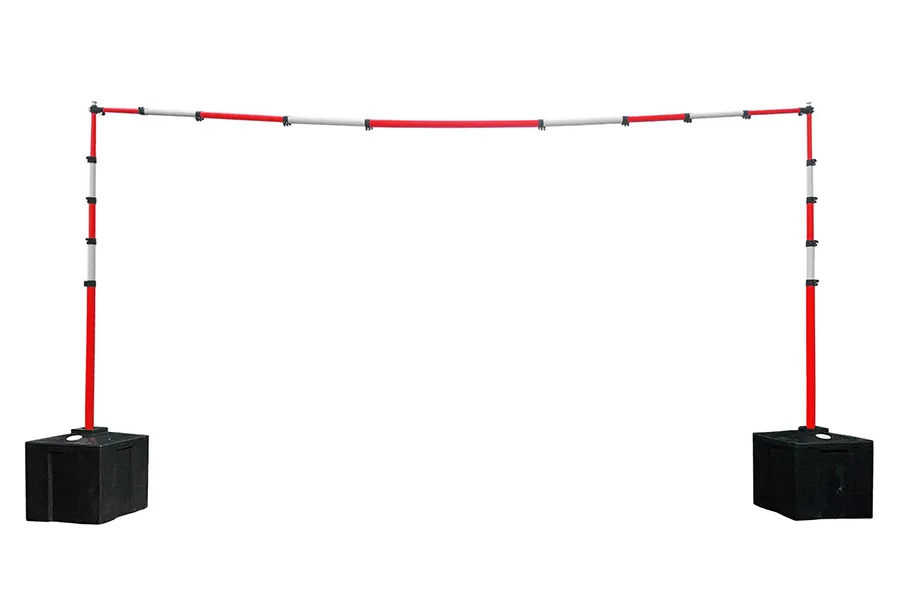
A height restriction barrier spans the approach at a set clearance, so cars pass beneath it and taller vans and trucks are turned away before they reach a low-clearance area such as an underground garage, a covered staff lot or a service road.
Fixed bollards
Fixed bollards, also called security posts, close a line to vehicles permanently while leaving it open to people on foot, which is the job along storefronts, pedestrian zones and the edges of a parking lot. Stainless steel bollards suit retail and urban frontages where appearance counts. Miter top bollards in galvanized or stainless steel suit commercial frontages and parking lot entrances, and yellow and black safety bollards mark and protect loading docks, warehouse aisles and service yards.
Retractable and telescopic parking posts
A retractable parking post locks upright to close a space or lane and drops into the ground when a vehicle is due, leaving a flush lid that cars and people cross without a trip hazard. It suits openings used occasionally, such as a reserved space, a driveway or a fleet yard after hours, where a fixed bollard would be in the way. Flush-fit stealth parking posts sit in a shallow ground socket when lowered, and telescopic security bollards collapse into a casing set in the ground.
Removable parking posts
Removable parking posts lift out of a ground socket and are stored while the opening is in use, then slot back in and take a padlock. They need only a shallow socket, which suits occasional access across a loading dock, a shared parking area or an industrial yard.
Concrete blocks and self-weighted barriers
Raise arm barriers and gates control who enters, while keeping vehicles out of an area altogether is done with mass. Concrete security blocks are set across an entrance or along a boundary with no bolting, and interlocking concrete jersey barriers join into a continuous wall around a compound or the edge of a lot. The crash-tested concrete barrier is the choice where a line must separate traffic from people on a road or jobsite, and the full precast range is under concrete barriers. For marking lanes and zones inside a site, self-weighted plastic barriers interlock and need no filling or ballast; they are for zoning and segregation, and a perimeter that has to stop a vehicle calls for the concrete units.


Manual or automatic barrier gate
The decision turns on power and staffing. A manual arm or swing gate needs no supply, so it goes in at construction compounds, remote lots and unmanned yards where running power to the entrance is impractical, and it suits moderate traffic where someone is on hand to lift the arm, or where the barrier stands locked open through the working day and is locked shut at night. Every post and bollard in the range also works without power.
An automatic barrier gate needs a single-phase power supply at the pedestal, and in return it opens without a person at the gate. It connects to fobs, tokens, proximity cards and intercoms, so only credentialed vehicles are admitted, and it handles the volume of a busy commercial entrance. Bi-folding speed gates follow the same logic for entrances that need a full gate and run around the clock, and they integrate with an existing access control system.
Commercial parking barriers for lots, compounds and yards
Commercial parking lots and business parks
Parking lot barriers at staff and visitor lots are judged on how smoothly the entrance flows at the start and end of the day and on who is let in. An automatic arm on the main entrance, linked to staff credentials, handles the peaks, while fixed bollards along sidewalks and building frontages keep cars off pedestrian areas.
Construction compounds and contractor staging areas
A compound gate is opened by the site team during working hours and locked at night, often before power reaches the entrance, so a manual or gas-assisted arm bolted to a concrete pad, or a swing arm gate, can control it from the first week. Concrete blocks across unused entrances stop vehicles from driving in after hours.
Logistics depots, fleet yards and service yards
Truck entrances are wide and vehicles turn in on a long swept path, so the opening width governs the choice of arm or gate. Depots with traffic at every shift change suit an automatic arm or bi-folding speed gates, while service yards and retail delivery lanes used a few times a day are controlled with a manual arm.


Parking lot barrier widths, installation and locking
Opening width
Measure the width of the traffic lane the barrier must close, with clearance at both ends, and choose the barrier for that figure. Raise arm barriers in the range span up to 29.5 ft, swing arm gates and rectangular gates suit narrower openings, and a skirt fitted below an arm reduces the span it can cover.
Fixing and installation
Arm barriers bolt down to a concrete base, and swing gate posts are set in concrete. Fixed bollards come embedded, for casting into a new concrete foundation as a permanent installation, or flanged, to bolt down to an existing concrete slab where digging is not wanted. Retractable posts need the deepest excavation of any type, since the body of the post drops below ground to a depth greater than its raised height, while removable posts need only a shallow socket. Concrete blocks and jersey barriers need no fixing, only firm, level ground and a forklift or lifting gear to place them.
Locking and keys
Arms and swing gates lock with a padlock in the open or closed position. Posts give more choice: padlockable retractable posts take a standard padlock supplied by the user, while retractable parking posts with an integral lock have a push-button lock built into the post with no external padlock. On a site with many posts, choose keyed-alike posts so one key opens every post, or randomly keyed posts where each space belongs to a different user. Telescopic bollards come with suited key options for fleet yards.
Finish and visibility
Galvanized steel suits exposed jobsites and yards, powder coating adds color for zoning or wayfinding, and brushed stainless steel suits frontages where appearance counts, with a higher grade available on request for coastal sites. Arms come in red and white or yellow and black, and reflective tape or bands on posts and bollards keep them visible to drivers after dark.
Popular Categories

Crowd & Pedestrian Barricades
View Products >

Traffic Barricades
View Products >

Expandable Barriers
View Products >
Frequently Asked Questions
In most uses there is none: boom barrier, boom gate, gate arm and barrier arm all name the same lifting arm that opens and closes a vehicle lane. Barrier gate is also used more widely by some suppliers for swing gates and folding gates that control the same kind of entrance.
Price follows the type. Removable posts, retractable posts and fixed bollards sit at the lower end of the range, manual raise arm barriers and swing gates in the middle, and automatic barrier gates and bi-folding speed gates at the top. Concrete bases, excavation, power and access control equipment add to the installed cost, and each product page shows its current price.
The low concrete blocks at the head of a parking space are wheel stops, also called parking blocks or parking curbs. Taller sections joined in a line along the edge of a lot or roadway are jersey barriers, and large square blocks placed across an entrance to keep vehicles out are concrete security blocks.
A line of fixed bollards along the edge of the grass keeps cars off it while leaving it open to people on foot, provided they are spaced so a car cannot pass between them. Where mowers or maintenance vehicles need to get on, a removable or retractable post in the line opens a gap. For a field used as temporary event parking, self-weighted plastic barriers laid along the edge mark the boundary without any fixing.
Concrete security blocks and interlocking jersey barriers have forklift slots, so they can be loaded onto a truck and set out again on the next job. Self-weighted plastic barriers are lifted by their rope handles, and water-filled barriers are drained, moved and refilled. The gas-assisted rising arm barrier and flanged bollards unbolt from their base, while embedded bollards and retractable posts stay in the concrete they are cast into.