















Fence Panel Storage Racks
Fence panel storage racks make temporary fence panels, crowd control barricades and the rest of a fence line safer to store and quicker to move between jobs. Panels and barricades take most of their damage in handling and transport, when loose frames rub against each other and bend under forklift tines. A rack that holds each item in place and lifts as one load keeps the fleet in service for longer. HERMEQ supplies steel racks and bins for mesh fence panels, steel site wall panels, crowd control barricades, plastic road barricades and rubber block fence feet.


Racks for fence panels, barricades and fence feet
Each rack in the range is built around one item on the fence line, so the choice starts with what the rack has to carry.
Temporary fence panel racks
The temporary fence panel rack is the one to choose for temporary mesh fence panels, the welded mesh panels that make up most perimeter runs. Forklift guides let a full rack go onto a truck in a single lift, and the removable arms come off so panels can be pulled out quickly at the fence line. It suits fleets that go out in bulk to construction sites and events and come back to the yard in full loads.
Steel site wall panel racks
The steel site wall panel rack carries the solid panels of steel construction fencing and other steel fence panels, which are heavier than mesh and need a frame built around their shape. It comes in two sizes for two panel heights, so a fleet of taller site wall panels and a fleet of standard ones each have a rack that fits. Choose it wherever a site is enclosed with a solid wall in place of mesh.
Crowd control barricade racks
The crowd control barricade rack takes fixed-leg, loose-leg and plastic barricades, so an event or construction fleet that mixes all three can share one rack type. Forklift guides are an option, worth adding where barricades move by forklift at the yard and the venue.
Road barricade racks
The road barricade rack is a stackable steel cage that keeps plastic road barricades upright in the depot and on the truck. It is sized by capacity, so the rack can be matched to the number of barricades a crew or a vehicle carries on a typical job.
Fence feet racks
Rubber block fence feet go out with every run of panels and are easy to leave loose in the back of a truck, where they shift and pile up. The range has two racks for them: the open fence feet rack and the drop-front fence feet bin. The next section sets out which one suits the way your crews handle feet.

Open rack or drop-front bin for fence feet
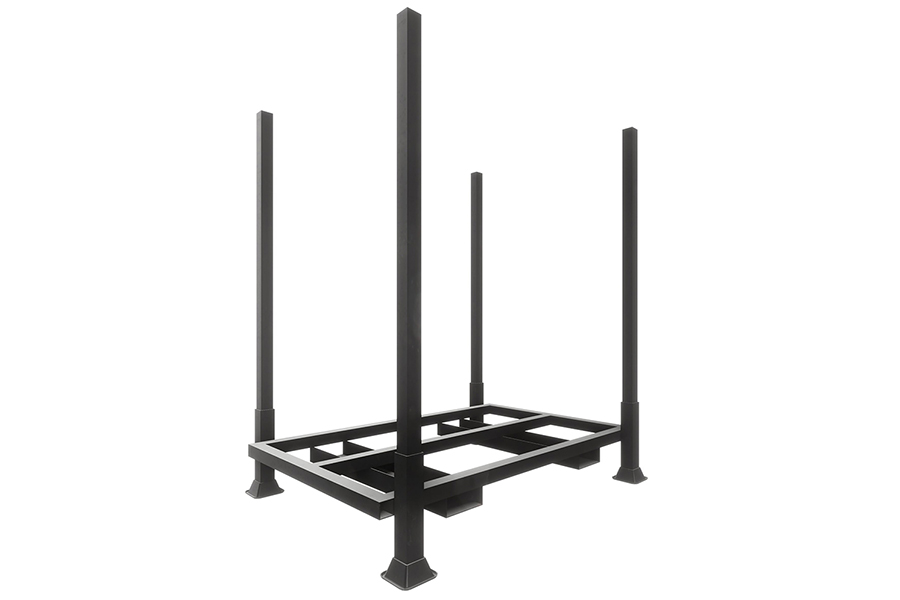
Both racks are built for rubber fence feet, so the choice turns on how the feet come out of the rack. The open fence feet rack is quick to empty through its removable arms, breaks down flat when it is not in use, and stacks on other full racks in the yard. The drop-front bin suits crews who unload heavy rubber feet by hand at the fence line. Its front door drops down, so feet slide out over the opening instead of being lifted over a high side, which is easier on a crew placing feet along a long run. The bin also has forklift guides, so it travels between jobs the same way as the panel racks.
Temporary fence storage for jobsites, events and highways
Construction sites and compounds
On a construction site, racks give panels and fence feet a fixed place in the compound between phases, off the ground where loose panels pick up mud and get run over by heavy equipment. When a stretch of fence comes down to let equipment through or to move the line, the panels go straight back into their rack and are lifted to the next position as one load, which keeps a site with changing boundaries in order.
Events and venues
Load-in and load-out at a venue run to tight windows, and crowd control barricades and mesh panels that arrive racked come off the truck by forklift in full loads instead of one piece at a time. At the end of the event they go back into the same racks, so the count leaving the venue matches the count that arrived and nothing is left behind on the grounds.
Highway and utility work
Plastic road barricades are light and bulky, and loose ones shift on a truck bed and scatter across a depot. Kept upright in a stackable cage, they travel as one block, and a crew can take the number a lane closure or a utility dig needs without sorting through a pile at the curb.


Fence storage rack sizes, capacity and stacking
Panel size and height
Every panel rack is built around one panel length and height, so measure the panels you run before choosing. Mesh panels, chain-link panels and steel site wall panels differ in both, and panels bought outside the HERMEQ temporary fencing range are worth checking against the panel size on the rack's product page. For site wall panels, choose the rack size that matches your panel height.
Capacity per job and per truck
Rack capacities across the range run from 20 to 50 items. Divide the panels in a typical run by the capacity of the panel rack to get the racks per run, then count how many loaded racks fit on your truck deck within its payload and how many fit in a yard bay. Order fence feet racks with the panel racks so each run's feet travel in matching racks, and add barricade racks for any crowd or road barricades that go out on the same job. A whole fence line then ships and stores as one matched set.
Forklift guides, arms and stacking
Forklift guides suit loads that move by forklift or telehandler at the yard and on site. Removable arms suit crews who unload by hand at the fence line, and stackable frames suit yards where floor space is short.
Painted finishes and color coding
Most of the range comes in a choice of painted colors. A yard can color-code racks by item, by crew or by customer, so a returned rack goes straight to its bay and a mixed load is quick to check on the truck.
Popular Categories

Temporary Fence Panels
View Products >

Construction Site Gates
View Products >

Acoustic Barriers
View Products >
Frequently Asked Questions
Set the rack on firm, level ground and take off the removable arms if the rack has them. Load the panels one at a time, square to the rack and with the frames lined up so no tube overhangs the side. Refit the arms once the rack is full and before it is lifted, and load the same number into every rack so the count stays simple.
Each loaded rack is strapped to the truck deck with ratchet straps over the frame, anchored to the deck's tie-down points, with edge protectors where a strap crosses a sharp edge. Racks are loaded tight against each other or against the headboard so they cannot slide. Where racks are stacked, the upper rack sits on the feet of the one below and the pair is strapped as one unit.
The temporary fence panel rack and the open fence feet rack have removable arms, and with the arms off the empty racks pack down flat. The road barricade and crowd control barricade racks keep their frames and stack on one another in the yard.
Racks are sold empty. The panels, barricades and fence feet they carry are sold separately, so you can rack a fleet you already own or order racks together with new stock.
The racks are steel with painted or powder-coated finishes, and they can be kept in an open yard. Stand them on firm, level, well-drained ground so stacks stay square and the bottom rack does not sit in water. Touch up any chips in the paint where the frame takes knocks from forks.