















Heavy Duty Saw Horses
HERMEQ heavy duty saw horses are adjustable steel trestle stands for construction and maintenance work, set in pairs or runs to carry a plank platform or a work surface. Each stand is tubular steel with a zinc-plated finish that resists corrosion on outdoor jobsites, in a compact frame that travels easily between jobs. Pin-locking legs set the working height in steps, and the 35 in head takes four scaffold planks to give painters, drywall finishers, installers and electricians a stable working platform. For elevated work, the range also includes stabilizers, ladder brackets, guardrail safety posts and S brackets.


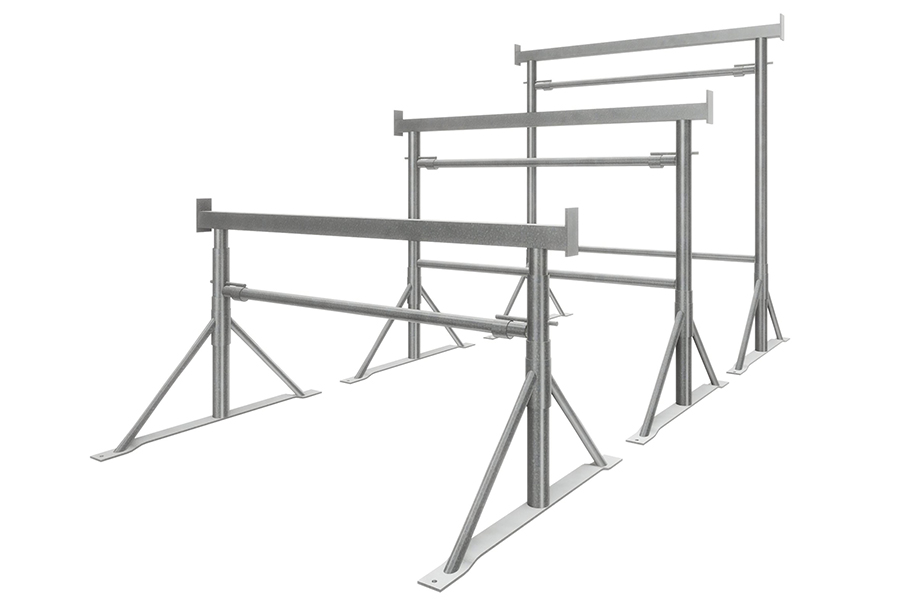
Adjustable saw horse heights in three sizes
The heavy duty adjustable saw horse comes in three sizes that together set working heights from 18 in to 66 in, and the right size is the one whose adjustment covers the height the work sits at.
Size 1 is the shortest stand and suits work close to the floor, such as a low bench for cutting and assembly, baseboard and trim, and flooring or tile preparation done kneeling or seated. Size 2 covers the middle heights, for mid and upper wall finishing, window and storefront installation and fixing at the head of door openings. Size 3 is the tallest, for ceilings, soffits, upper walls and overhead mechanical and electrical runs. At its upper settings the platform sits above 4 ft, so a Size 3 run is usually planned with stabilizers and guardrails from the start.

Saw horse table or standing platform
The same steel saw horse works as a bench or as a platform people stand on, and the difference between the two lies in the planks, the spacing, the ground and the way up.
As a cutting or assembly table, two stands set to the same height with a couple of planks or a sheet of plywood across them are enough for cutting, fabrication and assembly, and the stands can go wherever the material needs support.
As a standing platform, planks fill the full width of the head and are supported at 4 ft centers, which is the spacing the load rating assumes. Every stand needs firm, level ground under all its feet, and the crew needs a proper way on and off, normally a ladder secured to the platform with a bracket. Climbing the frame of a stand is not a means of access.
Once the platform is above 4 ft, each stand takes a stabilizer and the open edges take guardrails, both of which are covered under accessories below.
Saw horses for drywall, plaster and painting
Each trade uses the stands differently, and the difference is mostly in how the run is laid out and how often it moves.
Drywall finishing, plaster and stucco
Taping, skim coating and plastering move along a wall in long passes, so a run of stands that spans the whole wall lets a finisher work end to end without stopping to move the platform. Wet material goes on the planks in small amounts, with the main mix kept at ground level in mortar tubs.
Painting
Painting changes height through the day, from baseboards to ceiling lines, so the pin adjustment is used often and the planks are lifted and reset more than in most trades. Indoors, temporary surface protection laid before the stands go up keeps finished floors clear of paint and of marks from the feet.


Weight capacity and finish of steel saw horses
Load and support spacing
The range is rated to a safe working load of 1,014 lb at 4 ft load centers, so the figure applies only when the stands are no more than 4 ft apart. A platform loaded with a crew, tools and material is planned from the planks first, because their length decides how many stands the run takes, with a stand under every 4 ft. Holding up a slab, beam or ceiling during construction is a different job, done with adjustable shoring posts.
Steel and finish for site use
Plastic and wood saw horses are made as benches for cutting and light assembly in a shop or at the tailgate. Where the stand also carries a plank platform, stays outdoors for the length of a job or rides on a truck between sites, tubular steel with a zinc-plated finish is the right choice, since the plating resists corrosion and the frame is built for daily site handling.
Saw horse platform accessories
A boarded run becomes a guarded, edge-protected platform in steps, and each accessory adds one part of that set-up.
Stabilizers
Saw horse stabilizers give each stand a wider footing that resists sideways movement and platform sway.
Guardrail safety posts
Guardrail safety posts fix to the head of each stand and hold planks as guardrails and toe boards, which turns an open platform into an edge-protected one. For a long guarded run along a building edge or an extended job at height, temporary handrail systems are built for that work.
Ladder brackets
A ladder bracket secures a ladder to the platform as a fixed way on and off. Where the job calls for a stair to a raised level, the range of temporary stairs covers it.
Access gates
A platform access gate closes the opening at the ladder so the guardrail line is unbroken when the gate is shut, and its locking action controls who comes onto the platform. It is installed with the ladder bracket at the face of the platform.
S brackets for planks, handrails and toe boards
S brackets join planks where they overlap and connect handrails and toe boards from one bay to the next, which keeps both the walking surface and the edge protection continuous along a long run.

Popular Categories

Shoring Posts
View Products >

Construction Site Equipment
View Products >

Mortar Tubs
View Products >
Frequently Asked Questions
A bench for cutting and assembly works best with the top close to the waist of the person using it, a little lower for sawing and handling heavy sheets and a little higher for detailed assembly. Size 2 at its lower settings gives most crews a waist-height bench.
You stand on the planks, never on the stand itself. A plank platform built across the full head, within the rated load and with stands at 4 ft centers, is a working platform. Standing on a single saw horse or on a bench set-up of one or two planks is not.
Divide the plank length into spans of 4 ft or less and add one stand, so that a stand sits under each plank end and at every 4 ft between them. On longer runs, the plank ends lap over a stand so that no span exceeds 4 ft.
No. A stepladder, step stool or box on the planks lifts the worker above the guardrails and puts an uneven point load on the platform. When the work is out of reach, raise the stands to a higher setting or move up a size.
Retract the legs to the closed setting, return each locking pin to its hole, fold the stand and stack it flat, which keeps the pins with the frames and the stack stable. Store them dry and check the pins, holes and feet before the stands go back out.