















Ground Protection Mats
HERMEQ supplies heavy duty and lightweight ground protection mats that give vehicles, heavy equipment and crews safe access over soft or unstable ground. The range runs from pedestrian walkway mats and grass protection mesh through HDPE track mats and aluminum trackway to hardwood crane mats for cranes and piling rigs. The mats prevent rutting and surface damage, so the jobsite stays cleaner and machines keep working in wet weather. Connectors, along with steel and plastic ground pins for joining and securing the mats, are supplied alongside them.


HDPE ground mats, roadway mats, trackway and crane mats
The range sorts by what crosses it: walkway and rubber mats carry people and carts, grass mesh and reinforcement grids carry cars and light trucks on turf, HDPE track mats and roadway mats carry heavy equipment, and aluminum trackway and hardwood crane mats take the heaviest loads.
HDPE ground protection mats
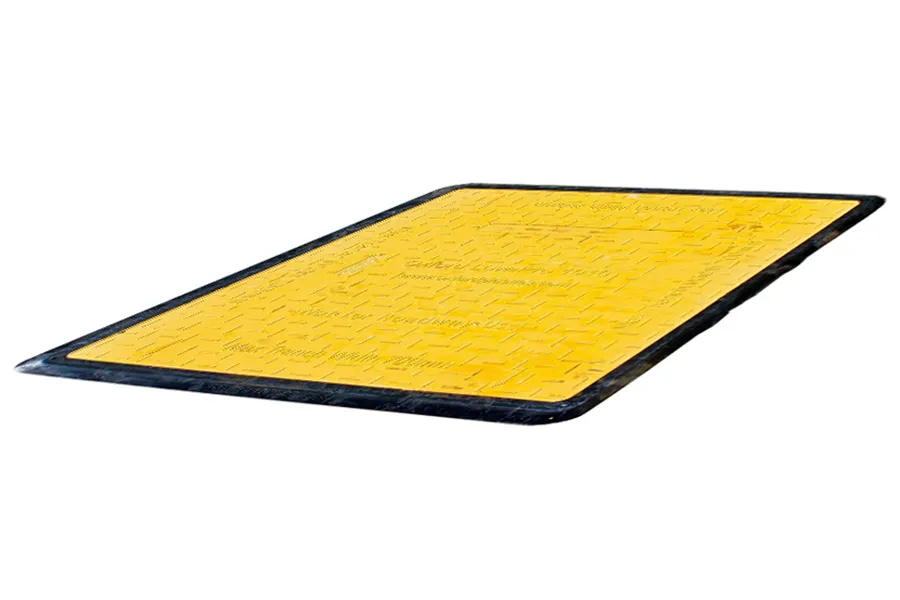
HDPE track mats are the everyday ground mats of construction and landscaping work: two workers carry one by its hand holes, the mats follow uneven ground, and the classes run from light duty ground protection mats for foot traffic and compact equipment to heavy duty mats for excavators, loaders and trucks. The 4x8 ground protection mats carry traffic on access roads and staging areas, while the lightweight 4x8 HDPE mats and the ContractorMat ground protection mats keep handling weight down for crews who relay mats every day. For lawns that stay covered for weeks, translucent white turf mats let light reach the grass, while high-visibility ground protection mats mark routes and turning areas in poor light. The Eurotrak heavy duty access mats and the machinery access mats carry traction treads for wheeled and tracked machines on mud, and used ground protection mats from earlier jobs are also listed.
Heavy duty roadway mats
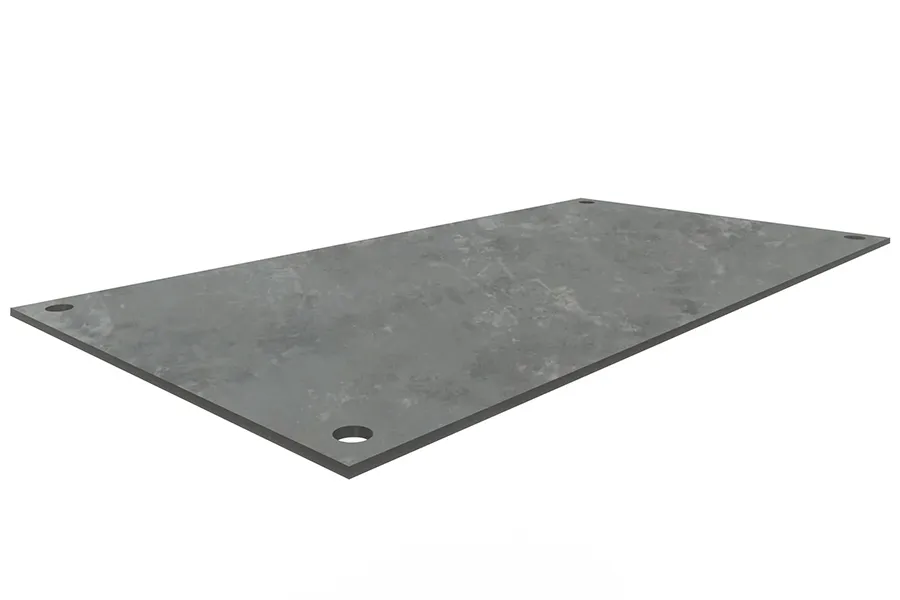
Heavy duty roadway mats are large UHMWPE panels for haul roads, staging pads and work platforms under cranes, dump trucks and tracked machinery, rated well beyond a standard 4x8 mat. Dedicated connectors join them in a line or a grid, so the same panels build a single-lane road on one job and a laydown pad on the next.
Aluminum trackway mats and rolls
Aluminum trackway takes the heaviest wheeled traffic in the range, up to 300,000 lb, on temporary roads over grass, gravel and soft ground for infrastructure, energy and event work. Aluminum trackway mats interlock panel to panel and are placed with a telehandler or small loader. Aluminum trackway rolls unroll a continuous road surface without mechanical assistance.
Timber crane mats
Hardwood mats are the crane mats of the trade: they build level platforms under mobile cranes and piling rigs, temporary roads across wetlands and soft fields, and working pads around substations, pipelines and rail lines. The full selection of species and sizes sits under timber crane mats. For the stabilizer legs of truck-mounted cranes and aerial lifts, the right product is outrigger pads, or high-visibility outrigger pads where the public passes close by.
Walkway and floor protection mats
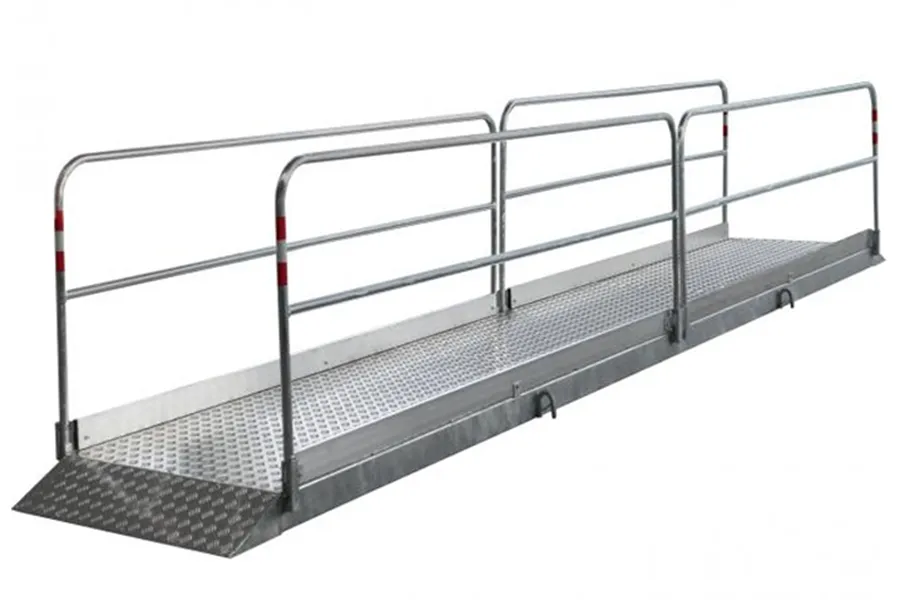
Walkway mats separate foot traffic from equipment and give crews, inspectors and the public a firm, slip-resistant route over mud, grass or a finished floor. Interlocking walkway mats join with a slot-and-key edge and take light vehicles as well as people, and the interlocking floor protection mats cover warehouse floors and indoor work areas in the same way. Temporary pedestrian walkway mats lay loose to mark crossings and queue lanes, and a roll-out site walkway in bright PVC unrolls along a route in minutes. At doorways and work-zone entries, spaghetti entrance matting drains water and holds dirt, while Terraguard event panels build anti-slip routes and staging areas across turf and gravel.
Grass protection mesh
Grass protection mesh is a flexible polyethylene roll laid straight onto turf, and the grass grows up through it, so a lawn, field or overflow parking lot keeps taking traffic season after season without rutting. Grades run from pedestrians and wheelchairs through cars and light commercial vehicles to occasional heavy trucks such as fire trucks. The ground stabilization mesh adds an anti-slip coating for public access routes, and the grass protection mesh rolls come in several widths and lengths for large event layouts and parks. Steel U-pins hold the mesh down on slopes and soft ground.
Ground reinforcement grids
Reinforcement grids are interlocking recycled plastic cells, filled with gravel or seeded turf, that turn grass or soil into a permanent drivable surface that still drains. The grass reinforcement grid is built for fire lanes, overflow parking and heavy equipment staging, and the X Grid ground reinforcement panels lay quickly for driveways, paths and site access routes.
Rubber grass mats
Rubber grass mats are open-mesh recycled rubber mats for paths, play areas, golf course maintenance zones and event fields, where grass grows through the openings and the rubber cushions falls near play equipment. They are fixed with plastic ground pegs and ties. Rubber grass matting lays over existing grass with no base works, and outdoor rubber safety mats give an anti-slip cellular surface for walkways, ramps and semi-permanent routes.


Plastic, timber or aluminum mats for heavy equipment
For most heavy equipment access, HDPE and UHMWPE plastic mats are the practical default. They are carried and placed by hand or by a small crew, flex slightly to sit on uneven ground without corner lift, absorb little water and resist chemicals. Because the polyethylene is non-conductive, plastic mats add a margin of safety when machines work near live equipment and overhead lines. Hardwood is the choice for crane and piling rig platforms and for jobs where mats stay down for months on wet, acidic or contaminated ground. Ekki hardwood crane mats have the highest bending strength of the timbers in the range, resist acid and weather, and insulate electrically. Tropical hardwood crane mats in Okan and Dabema keep strong water and decay resistance at a lower cost, and oak and beech crane mats are the economy choice for day-to-day crane pads and machine staging. Aluminum mats carry the heaviest wheeled loads for their weight, resist corrosion and have a long service life, which lowers lifecycle cost for contractors who build haul roads repeatedly.
What ground protection mats are used for
Temporary access roads and haul routes
An access road has to carry the heaviest loaded vehicle that will use it, so the whole route is matted to that class, every joint is connected so mats cannot spread under braking and turning trucks, and the vehicle traction face goes up. Where the route meets an open excavation, it changes to steel road plates from the sitework and shoring equipment range.
Crane and piling rig setups
A crane or piling rig puts its weight down through tracks or outriggers onto a small area, so the platform needs a level base and mats that extend well beyond the machine footprint to spread the load before it reaches soft ground. Hardwood crane mats and heavy duty roadway mats are the usual platforms, and the lift plan sets the ground bearing pressure the mats have to bring the load down to.
Utility, pipeline and power line work
Utility and pipeline crews work along long, narrow routes across farmland, wetland and private yards, so they need mats light enough to leapfrog forward by hand and a smooth face that leaves turf easy to reinstate.
Events, lawns and turf
On event fields, golf courses, parks and residential lawns, the condition of the grass after the job counts as much as access during it. HDPE mats go down smooth side to the turf, and ramped edges go wherever the public walks onto the mats.


Heavy duty mat load ratings, sizes and tread
Load rating and ground conditions
Load ratings on plastic mats are quoted subject to ground conditions, because the same mat carries less on saturated clay or loose fill than on compacted gravel. On soft, waterlogged or freshly backfilled ground, step up one class, or move to heavy duty roadway mats where heavy loads will pass repeatedly.
Mat size, handling and storage
The 4x8 mat is the standard size in the trade, the same footprint as a sheet of plywood, and two workers handle one comfortably. Narrow 2x8 ground protection mats go through yard gates, side yards and the gap between a building and its fence, where a full-width mat will not fit. Ground mat storage racks hold stacks of 4x8 mats for forklift loading and stack on top of each other in the yard.
Surface tread
Diamond tread grips both tires and boots and suits mixed traffic. Deep, high-profile traction cleats bite into mud for wheeled and tracked machines, and dual-sided mats carry a vehicle tread on one face and a finer pedestrian tread on the other, so one mat can be turned to suit the route.
Temporary cover or permanent reinforcement
Mats are temporary cover: they go down for the job and come up when it ends, and grass left under solid mats for long periods yellows from lack of light. Where traffic will cross the same grass for a whole season or for good, such as overflow parking, fire lanes or a festival site used every year, choose grass mesh or reinforcement grids, which stay in place while the grass keeps growing through them.
Popular Categories

Road Forms
View Products >

Road Plates
View Products >

Crane Mats
View Products >
Frequently Asked Questions
A mat spreads the weight of a wheel or track over a much larger area of ground, which lowers the pressure on the soil beneath. The ground then carries the load without the tire sinking, so the mat stops rutting, keeps vehicles from bogging down and protects turf, sidewalks and paved surfaces.
Clear the route of stumps, rocks and sharp debris and fill deep holes so each mat sits flat. Start from firm ground and work outward, laying the long edge in the direction of travel and staggering the joints on wider roads. On long routes, the next mat is placed from the one just laid, and each joint is connected before vehicles cross.
HDPE mats join through their hand holes with 2-way and 4-way metal connectors, which lock a road or pad into one surface. For short-term loose lay, cable ties through the holes hold mats together. On slopes and slippery ground, steel U-pins driven through the holes keep mats from creeping, and plastic ground pegs fix rubber grass mats and grass mesh.
A crane mat is a large timber, plastic or aluminum mat laid to form a platform under a crane's tracks or outriggers, or a road for the crane to travel on. A crane pad, usually called an outrigger pad, is a smaller polyethylene pad placed under a single stabilizer foot to spread its load. Truck-mounted cranes and aerial lifts on firm ground generally set up on pads, while crawler cranes and machines on soft ground need a full mat platform.
The used ground protection mats in the range have been on one previous job. They are a little dirty but carry no structural damage. They suit a single project or a reserve stock of heavy duty mats where appearance does not matter.
Several types in the range can be cut on site. Narrow HDPE mats trim with a jigsaw to fit around poles, drains and edging. Grass protection mesh, spaghetti matting and rubber grass mats cut with a utility knife to fit irregular areas and edges.