













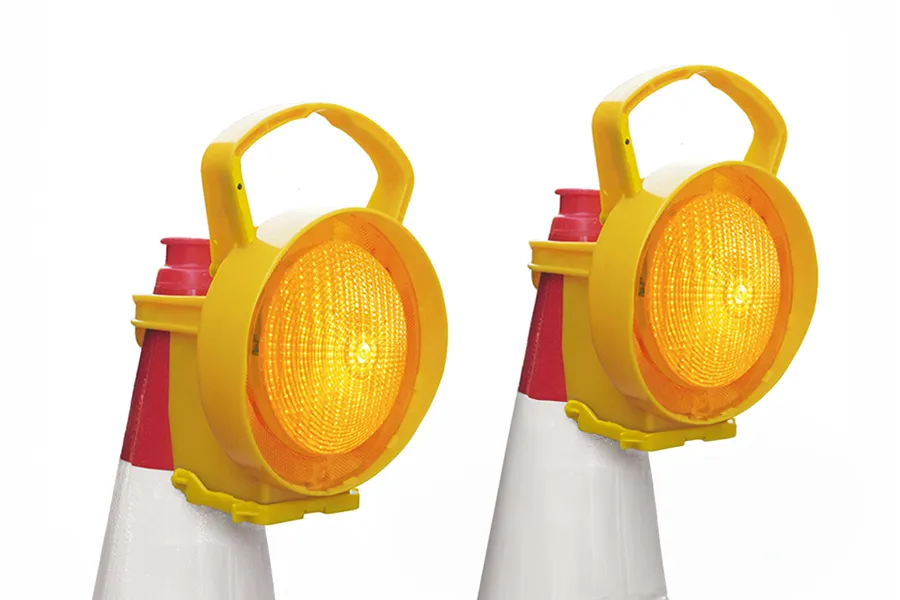


Traffic Cone Lights
HERMEQ traffic cone lights are LED lamps for temporary traffic control at night and in low light, on roadwork, construction, municipal and facilities jobs. They attach to traffic safety cones, and several also mount on folding signs and barriers, so a work zone stays visible after dark and road signs can be lit for drivers to read. The range covers compact cone-top lights, flashing and steady warning lamps, infrared-synchronized sequential taper lamps and a high-intensity white sign light, in amber, blue, red, magenta and white.


LED traffic cone lights for hazards, tapers and signs
Each lamp in the range does one of four jobs: warning drivers of a hazard, marking a path along a line of cones, guiding traffic through a lane closure taper, or lighting a sign so it can be read. All of them are made for standard traffic cones, and the job decides the type.
Compact 360-degree cone-top lights
The compact 360-degree traffic cone light seats in the opening at the top of a cone and shows amber light all the way around. It suits low-speed work where drivers, equipment operators and pedestrians approach from every direction, such as parking lots, yards, loading areas and sidewalk closures, and it adds very little bulk or weight to the cone it sits on.
High-intensity flashing lights
The Star-Flash high-intensity LED flasher is a bracket-mounted warning lamp with a large lens and a strong flash. Choose it for the advance end of a work zone and for hazards on faster roads, where drivers need to pick out the warning from a long way back and slow down in time.
Sequential taper lamps
Sequential taper lamps link to one another by infrared and flash one after another along a row of cones, so the light travels in the direction traffic has to merge. They are made for highway lane closures, exit closures and long tapers, where a driver approaching at speed has a moment to read which way the lane is shifting.
White sign lights
The SignLite LED sign light is a white, single-lens lamp that lights the face of a road sign at night. It looks similar to the amber warning lamps, but the two do different jobs: an amber lamp shows drivers where the sign is, while the white light lets them read what it says, which matters for detour, lane closed and road closed signs on unlit roads.
Two-sided warning lamps
The MonoLight two-sided cone lamp has a lens on each face and mounts on cones or barriers. It is the everyday warning and delineation lamp for two-way streets, utility and paving work in the middle of a road, and closures that traffic passes from both ends.
Single-sided warning lamps
The ConiLamp single-sided warning lamp puts its light through one large lens and switches itself on and off. It is a straightforward warning lamp for long cone lines on highway shoulders and lane closures, where every lamp in the line faces the same oncoming traffic.


Flashing, steady or sequential cone lights
The light mode should match what the lamp has to tell the driver. A flashing lamp draws the eye to one point, so it belongs on an isolated hazard such as an open excavation, a stopped truck or a damaged curb, and on the first cones and signs at the approach to a work zone. Steady lamps along a run of cones read as a continuous edge that drivers follow through a channelized lane or around a work area, while a long line of flashers makes the same path harder to judge because each lamp pulls attention on its own. Sequential lamps flash one after another along a taper and show drivers both where the closed lane ends and which way to move.
In the range, the compact cone-top light and the MonoLight switch between steady and flashing, the Star-Flash is a flasher, and the sequential taper lamps run as a synchronized set. A single closure often uses all three modes: flashing lamps in the advance warning area, sequential lamps across the taper and steady lamps along the length of the work, set out with the cones, barricades and signs from the wider range of traffic management equipment.
Cone lamp color, direction and battery life
Light color
Amber is the general warning color for work zones and the default for cone lines, barricades and advance warning on most roadwork and construction jobs. White is for lighting signs, which is why the sign light is the only white lamp in the range. Blue, red and magenta lamps are available where the traffic control plan, the site owner or the agency calls for a different color to set one hazard or area apart.
One-sided, two-sided or 360-degree
Where traffic comes from decides how many directions the lamp must face. A single-sided lamp is enough where all traffic approaches one way, a two-sided lamp covers two-way roads and work that drivers pass from both ends, including a run of road barricades or water filled barriers seen from both approaches, and a 360-degree light suits open areas such as intersections, parking lots and pedestrian routes where people arrive from any side. Directional lamps only warn when the lens faces the traffic, so each cone needs turning as it is placed, and the line needs rechecking after cones have been knocked or moved.
Batteries and runtime
The compact cone-top light runs on standard AA alkaline batteries. The bracket lamps run on 6V batteries, either the Premium 800 or the larger Konstant 25 and Konstant 45, and the same lamp runs several times longer on a Konstant battery than on a Premium 800. Across the range, runtimes go from about 150 hours for the sign light on a Premium 800 to more than 3,000 hours for a two-sided lamp flashing on a Konstant 25, and any lamp set to flash lasts longer than the same lamp on steady burn. Lamps with a daylight sensor switch off during the day and draw on the battery only in darkness. Counting the hours of darkness over the whole closure and choosing the battery to match lets the lamps run from setup to removal without a battery change on a live road.

Popular Categories

Road Barricades
View Products >

Water Filled Barriers
View Products >

Traffic Cones
View Products >
Frequently Asked Questions
It is a standard traffic cone with a battery lamp fitted to its top, either seated in the top opening or held by a bracket, and set to flash. A lighted traffic cone has LEDs built into the cone body itself. The lamps in this range fit cones a crew already owns, so one set of lamps can move between cones and the cones can be stacked and stored without them.
It depends on the lamp. The compact cone-top light has a switch for steady or flashing operation, and the sequential taper lamps switch on by themselves when they are placed on a cone. The ConiLamp turns on and off automatically, and the MonoLight and SignLite have daylight sensors that switch them off in daylight and back on at dusk.
The compact cone-top light fits cones with a top opening from 1.1 to 1.8 in and is made to work with HERMEQ Starlite and Master traffic cones. The other lamps attach to the cone with a bracket. Measuring the top opening of the cones in your fleet before ordering confirms which lamps will seat in them.
Several of them can. The Star-Flash mounts on folding signs as well as cones, and the MonoLight mounts on barriers as well as cones.
The lamps are built for outdoor work zones, with polycarbonate lenses on the MonoLight and SignLite and an IP54 rating on the compact cone-top light. For fog, heavy rain and night work on faster roads, the Star-Flash high-intensity flasher is the lamp in the range made for those conditions.