













Barrier Gates
HERMEQ barrier gates and bollards control vehicle access at parking lots, depots, construction compounds, checkpoints and access-controlled zones. For long-term restriction in secured areas, the range covers fixed bollards and removable and retractable parking posts. For managing entry and exit, it covers manual and automatic raise arm barriers, swing arm and framed swing gates, and automatic swing and bi-folding gates.
Manual barriers run without a power supply or electrical work and are lifted and locked by hand, which keeps installation simple and upkeep low. Automatic boom gates and full-height gates open on their own for frequent, credentialed traffic.


Boom gates, swing gates and parking barrier posts
The choice starts with what the entrance has to do: an arm or swing barrier controls which vehicles drive through, a full-height gate closes the opening, and bollards or posts keep vehicles out of a space.
Manual raise arm barriers
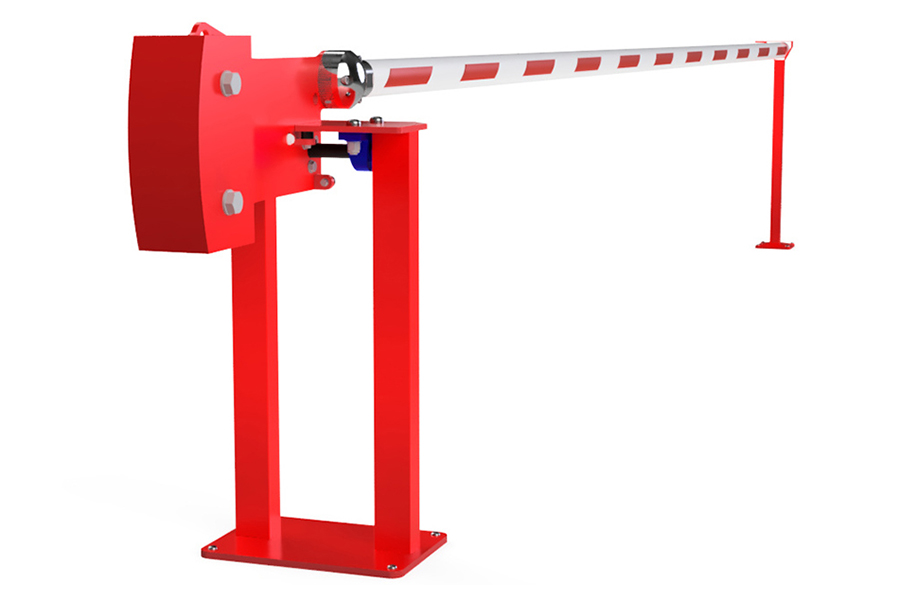
A counterbalanced arm on a steel pedestal, lifted by hand, is the usual barrier for lot, compound and private road entrances. The standard manual raise arm barrier covers typical lot and access road widths. For wide truck entrances and shared yard access, the heavy duty raise arm barrier has the longest reach of the manual arms. The gas-assisted rising arm barrier bolts down quickly, so it suits overflow lots, event venues and seasonal entrances.
Automatic boom gates
The automatic boom gate raises and lowers its arm by motor, with no counterweights and a programmable arm speed. Choose it for commercial lots, business parks, toll lanes, service roads and emergency access lanes, where vehicles arrive all day and nobody is stationed at the entrance to lift an arm.
Swing arm and swing gate barriers
A swing barrier pivots sideways on a hinge post, so it needs no headroom and works under trees, canopies or overhead lines, provided there is clear ground for it to swing through. The swing arm gate is a single steel arm for low-traffic entrances such as rural and utility roads, unmanned sites, contractor staging areas and fleet yards. The rectangular parking lot gate is a galvanized framed gate hung between a hang post and a slam post, and it closes a lot, warehouse lane or service yard with more body than a single arm.
Automatic swing and bi-folding gates
Motorized full-height gates close the entrance to a depot, industrial yard or distribution center completely. The automatic swing gate opens through 180 degrees to give large vehicles the full width, and it needs clear ground on the side it swings into. Where that space is not available, the automatic bi-folding gate folds inward in a few seconds and takes far less room. The bi-folding speed gates run without a ground track across the opening and are built for high-cycle entrances that operate around the clock.
Fixed bollards
A fixed bollard closes a route to vehicles for good while people walk between the posts, so it belongs where an access point never needs to open. Stainless steel bollards with a brushed finish suit pedestrian zones, shopping centers and urban streetscapes. Miter top bollards have an angled cap that sits well at building frontages and entrance plazas. Around loading docks, warehouses and service yards, yellow and black safety bollards give drivers a galvanized post with reflective bands they can see in poor light.
Removable and retractable parking posts
Posts that come out of the ground suit access points that open from time to time. Removable parking posts lift out of a ground socket and are the simpler choice when access is occasional, such as a reserved parking space or a seldom-used loading dock. Where a post goes up and down every day, a retractable post lowers into its socket under a flush lid. The padlockable retractable posts come in galvanized or stainless steel. For a clean finish with no external lock, choose retractable posts with an integral lock. Driveways and private spaces that call for a discreet socket take the flush-fit stealth parking posts.

Manual or automatic barrier gate
The entrance itself settles this choice: whether it has power, whether anyone is there to open it and how many vehicles pass through in a day.
A manual barrier gate is the right choice for unmanned lots, construction compounds, temporary entrances and remote service roads where traffic is occasional. The standard and heavy duty raise arm barriers and the swing arm gate lock in the open or closed position with a padlock, which lets you leave an entrance open through the working day and secure it at night. Where an arm is lifted many times a shift, the gas strut on the rising arm model makes each lift lighter.
An automatic boom gate runs on a single-phase supply and is the choice when entry is frequent and only authorized drivers may pass. It accepts fobs, tokens, proximity cards and intercoms.
Barrier gates for parking lots, yards and depots
Parking lots and business parks
Traffic volume and who is allowed in decide the barrier at a lot. A staff lot or business park entrance with a steady flow of permit holders needs a barrier that opens without an attendant, while an overflow lot that fills a few times a year can be run by hand. Separate entry and exit lanes, each with its own barrier, stop a queue of arriving cars from blocking those leaving.
Construction compounds and contractor yards
A compound has to be locked outside working hours, and its entrance has to clear the longest delivery truck and the heavy equipment that will use it, measured along the turning path as well as across the opening.
Logistics depots and distribution centers
Shift change tests a depot entrance, when staff cars and trucks arrive and leave in the same short window. A slow gate backs vehicles up onto the public road, so opening speed and the number of lanes count for more here than at any other site. Many depots split trucks and cars, with a full-height gate on the truck yard and a barrier arm on the staff lot.
Driveways, storefronts and pedestrian zones
A lowered retractable post sits flush, so the closed socket is safe to walk over and to cross with a stroller or wheelchair, and reflective bands keep raised posts visible at night. Space bollards so a car cannot pass between them while wheelchairs, strollers and delivery carts can, and put a removable or retractable post in the line wherever emergency or service vehicles need occasional entry.


Barrier gate widths, security and fixing
Width of the entrance
Measure the clear opening at its narrowest point, between curbs, walls or fence posts, and allow room beside it for the pedestal or hinge post. Manual raise arms in the range reach up to 29.5 ft, and the full-height gates span up to 32.8 ft. A skirt hung below an arm shortens its maximum reach, so check the length with the skirt fitted. Truck entries to yards and other openings wider than a standard arm go to the heavy duty raise arm barrier or a double leaf gate.
Level of security
A barrier arm stops vehicles but leaves the opening passable on foot, so it controls traffic without closing the site. Where a depot or yard must be shut to people as well, an automatic swing or bi-folding gate closes openings up to 7.9 ft high.
Ground and fixing
Bolt-down barrier pedestals and flanged bollards anchor into a sound concrete base, so plan a pad where the entrance is asphalt, gravel or fill. Cast-in bollards and the hang and slam posts of the rectangular parking lot gate are set in concrete. Retractable post sockets need an excavation with drainage below, so water does not stand in the socket. Before any digging, have buried utilities located and check the line of the posts for drains, cables and pipes.
Finish and corrosion resistance
Galvanized steel suits most lots and yards and is the finish on the rectangular gate, the automatic gates, the removable posts and the safety bollards. Powder coating adds color for visibility, branding or zone marking. Stainless steel resists corrosion with a brushed look for public frontages. Grade 304 is standard on the stainless bollards, and Grade 316 is available on request for coastal sites and streets treated with de-icing salt.
Popular Categories

Ground Mats
View Products >
Steel Road Plates & Trench Covers
View Products >

Timber Mats
View Products >
Frequently Asked Questions
A boom gate is a barrier made of a single horizontal arm, the boom, that pivots up to let a vehicle through and lowers to stop the next one. The word boom means a long pole or spar, which is what the arm is. The same product is also called a barrier gate, boom barrier, barrier arm, arm gate, bar gate or raise arm barrier, and at a lot entrance a parking lot barrier gate.
The price depends mainly on whether the barrier is manual or automatic, on the span it has to cover, and on whether the entrance needs an arm or a full-height gate. Each product page lists the price for every size and option.
A skirt fitted to a manual raise arm barrier closes much of the space between the lowered arm and the ground. It discourages people from walking or cycling underneath the arm. Skirts are available for the standard and heavy duty manual raise arm barriers.
Raise arm barriers and the automatic boom gate come in red and white, and several models also come in yellow and black. The swing arm gate is powder coated yellow. The standard manual raise arm barrier has an arm finished in high-visibility vinyl tape, with custom colors available on request to match a site's branding or safety zoning.
Removable parking posts take a padlock, and a security version of the removable post is available. The padlockable retractable post locks upright with a padlock you supply, while the integral lock post has a built-in 7-pin push-button lock opened by key, with optional lift assist on larger sizes. The stealth post uses a spring-loaded barrel lock with keys supplied, either identically keyed across a set or randomly keyed.